SCIENCEWhat does SCIENCE mean?
Established science or active scientific research. The story is grounded in scientific evidence or an active research question. The frontier may still be uncertain. See the full glossary →
Curious Behavior of Neutron Stars
Neutron stars are the remnants of collapsed giant stars, condensed into spheres about 20 kilometers in diameter but with a mass 1.4 times that
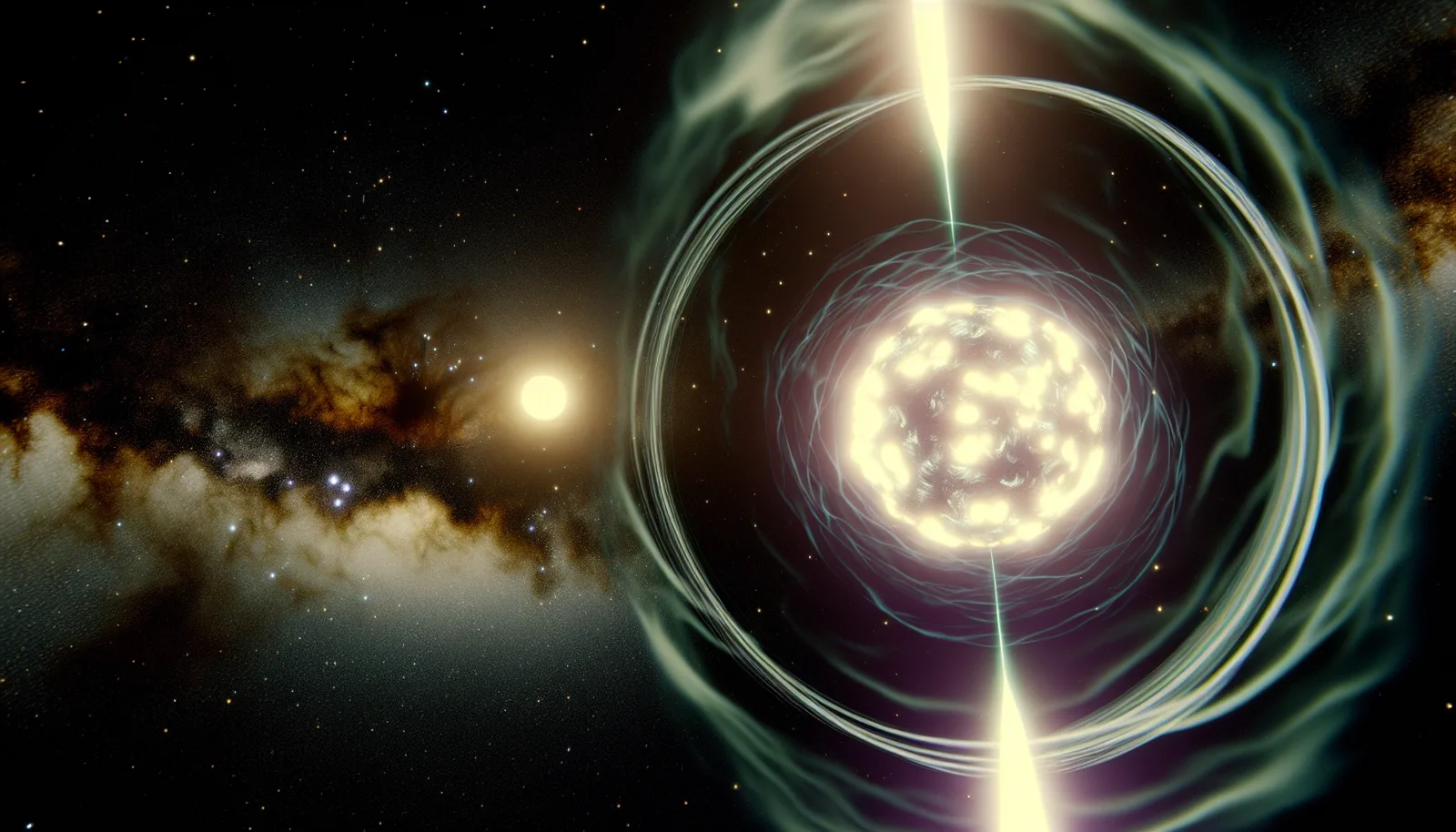
Have you ever wondered what happens when a star collapses under its own gravitational force? The result is a fascinating cosmic phenomenon — a neutron star. Neutron stars, an element of nature just as thrilling as it is curiously odd. Decoding their behavior can provide us with a glimpse into the mechanics of the universe at large. Let’s embark on this space-physics exploration.
What are Neutron Stars?
Neutron stars, remnants of a collapsed giant star, are predominantly composed of — as the name suggests — neutrons. These celestial objects are remarkably small, yet their mass is nearly 1.4 times that of our sun, packed into a sphere with a diameter of around only 20 kilometers.
Just imagine! All those school buses, elephants, and skyscrapers put together, crammed into a small object that could easily fit into a large city. Its staggering density leads to an incredible gravitational force, one so strong that it significantly bends the surrounding space and time.
The Birth of a Neutron Star
Neutron stars are not eternal. They are born from the ashes of massive stars undergoing a supernova explosion, a cosmological cataclysm that spreads elements throughout the universe, aiding in the creation of new stars, planets, and even life.
When a star burns out its nuclear fuel, the pressure from the heat no longer supports the enormous mass trying to collapse under its own gravity. This leads to an astronomically big implosion and then a rebound, triggering a supernova.
Unique Physical Properties
Neutron stars are unique celestial bodies with unusual physical properties that make them interesting subjects of study:
Pulsating Lighthouse: They give off beams of radiation from their magnetic poles that sweep across the universe like the light from a lighthouse. Hence, we may perceive them as ‘pulsating’ whenever the radiation is pointed in the direction of Earth.
Magnetism: Neutron stars have highly turbulent magnetic fields, up to a trillion times stronger than Earth’s. These fields drive particles to accelerate near the speed of light, emitting intense radiation that astronomers can detect.
Fast Rotation: Their rapid rotation is another intriguing aspect, spinning many times per second.
Neutron Stars and Black Holes
In the hierarchical ladder of celestial objects, neutron stars hold their position just a notch below black holes. They are a last-ditch gravitational stand against becoming a black hole. If a neutron star’s mass increases beyond a critical limit, its gravity overwhelms all other forces and it collapses into a black hole.
Here’s a fun fact, some neutron stars have even been seen cannibalizing each other, forming larger neutron stars or even black holes.
A Neutron Star’s Life
Birth:
Middle Age:
Death:
The Importance of Studying Neutron Stars
Despite varying theories surrounding neutron stars, one thing is clear — they provide a natural lab for testing the physics of extreme conditions not reproducible on Earth. Their study opens a window into understanding gravity, matter, and energy to a degree that no terrestrial lab could ever achieve.
Conclusion
In the grand scheme of astrophysics, neutron stars may seem like diminutive specks. But their extreme characteristics and behavior make them incredibly engaging subjects and play a pivotal role in understanding the cosmos. The next time you look up at the star-lit sky, take a moment to appreciate neutron stars and their curious behavior. This exploration of the bizarre, dense jewels of the cosmos is just a glimpse into what the universe has in store. Who knows which celestial mystery we might unravel next?
Sources & further reading
Use NASA Science, NOAA Ocean Service, Smithsonian, and Encyclopaedia Britannica as starting points. Specific claims should be checked against primary research and archival sources.
Go down the rabbit hole
Surprise me →
Why Galaxies Rotate Like They Have Invisible Company
Stars at the edges of galaxies move too fast for visible matter alone to explain. That mismatch is one of dark matter's biggest clues.
The Cosmic Microwave Background: The Baby Picture With Tiny Cosmic Clues
The oldest light in the universe looks nearly smooth—until its faint temperature variations reveal the seeds of galaxies.
Mysterious Cosmic Microwave Background
In the 1960s, a groundbreaking discovery was made that forever shifted our perception of the cosmos – the Cosmic Microwave Background. This faint radiation,